

Overview
Building an enterprise planning model traditionally starts with requirements gathering, architecture design, data configuration, formulas, and dashboards. Pigment’s Modeler Agent introduces a different starting point: describe what you want to build, and AI can help turn that intent into the foundation of a working planning model.
This goes beyond asking a chatbot questions about your data. The Modeler Agent can actively participate in building the planning environment itself.
From Business Intent to Model Architecture
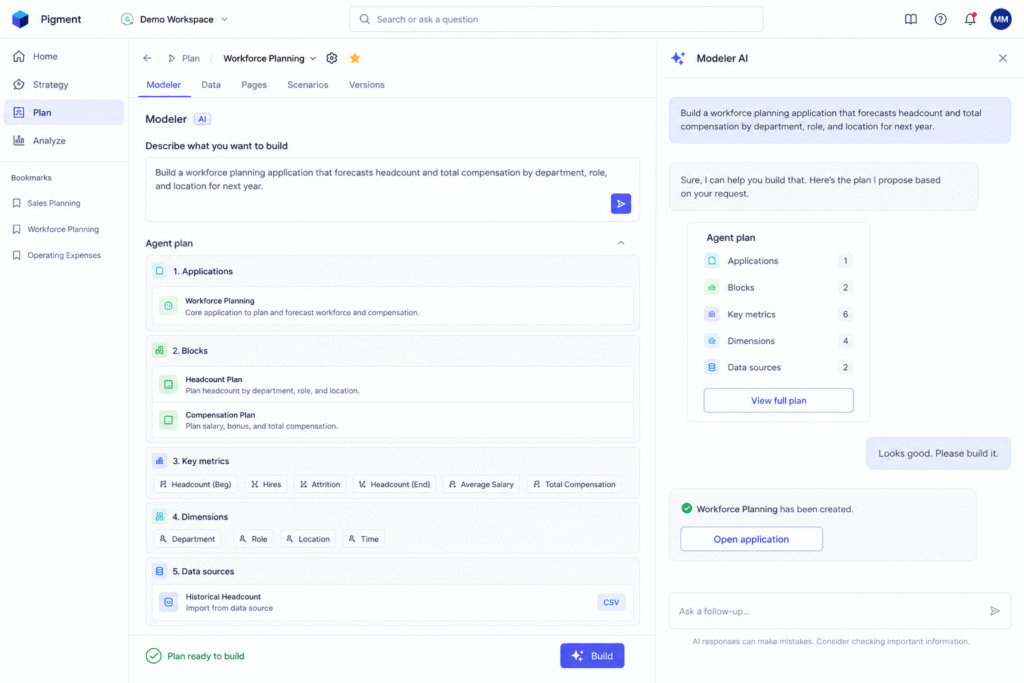
The Modeler Agent uses natural-language prompts to help translate planning requirements into model components. A typical workflow looks something like this:
Describe the intent > Review the proposed plan > Let the agent build > Validate and iterate
For example, a user might describe the need for a workforce planning application that forecasts headcount and compensation by department, role, and location. Rather than manually creating every component from scratch, the Modeler Agent can help establish the underlying structure needed to support that use case.
Depending on the requirements, this can include:
- Applications and planning blocks
- Dimensions, lists, and metrics
- Formulas and calculations
- Data imports
- Tables, charts, and other visualizations
The user can then review what was created, refine the requirements, and continue iterating with the agent.
More Than a Planning Chatbot
The distinction between a chatbot and an AI model-building agent is important. A traditional AI assistant might explain how to build a workforce forecast or suggest a formula. Pigment’s Modeler Agent can help construct the model components required to do it.
That shifts AI from simply answering planning questions toward participating in the development process, potentially reducing some of the repetitive configuration involved in creating and modifying planning applications.
Where the Human Modeler Still Matters
AI-assisted model building does not eliminate the need for experienced modelers. Enterprise planning models depend on far more than formulas and configuration. Human expertise remains critical for determining the right architecture, validating calculations, establishing controls, understanding business requirements, and ensuring the model will remain scalable and maintainable.
The Modeler Agent can accelerate the building. The modeler still provides the judgment.
That combination may ultimately be where the greatest value lies: allowing experienced practitioners to spend less time on repetitive configuration and more time solving the business and architectural problems that require expertise.
What This Means for FP&A
For finance and planning teams, the Modeler Agent represents a broader shift toward AI-assisted financial modeling and FP&A automation. Instead of starting every new planning requirement with a blank model, teams can increasingly start with business intent, use AI to accelerate the initial build, and then apply human expertise to refine and govern the result.
The question is becoming less “Can AI answer questions about our planning model?” and more “How much of the model-building process can AI help us accelerate?”
See What Modeler Agent Could Accelerate in Your Planning Environment
Want to understand where Pigment’s Modeler Agent could save time in a real implementation? QueBIT can help assess your planning requirements, identify opportunities for agent-assisted model building, and determine where human modeling expertise delivers the greatest value.