
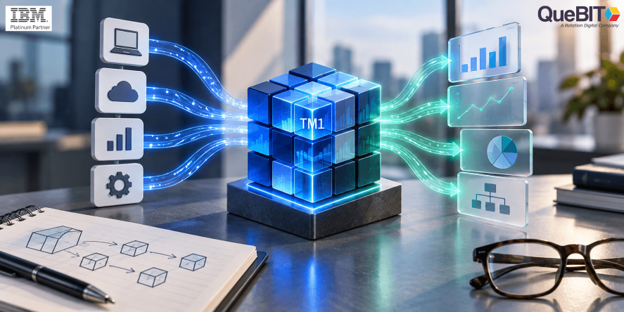
Artificial intelligence can analyze data, but enterprise planning requires something more: business context.
An AI model does not automatically understand your TM1 cubes, dimensions, hierarchies, calculations, processes, or planning logic. IBM's support for Model Context Protocol (MCP) in Planning Analytics could help bridge that gap.
MCP gives AI agents and external applications a standardized way to interact with Planning Analytics capabilities, potentially changing how users and AI systems work with TM1.
What Is MCP?
Model Context Protocol (MCP) is an open standard that allows AI applications and agents to connect with external systems, data, and tools.
For Planning Analytics, IBM exposes defined TM1 capabilities as MCP tools that an AI agent can discover and use.
This is important because MCP goes beyond simply asking TM1 for a number. IBM documents tools for working with areas such as:
- TM1 servers and cubes
- Dimensions, hierarchies, and metadata
- Cube queries and MDX
- TM1 processes
- Views and operational information
Instead of requiring users to know exactly where information lives or how to retrieve it, an AI agent can use available tools to help determine how to interact with the Planning Analytics environment.
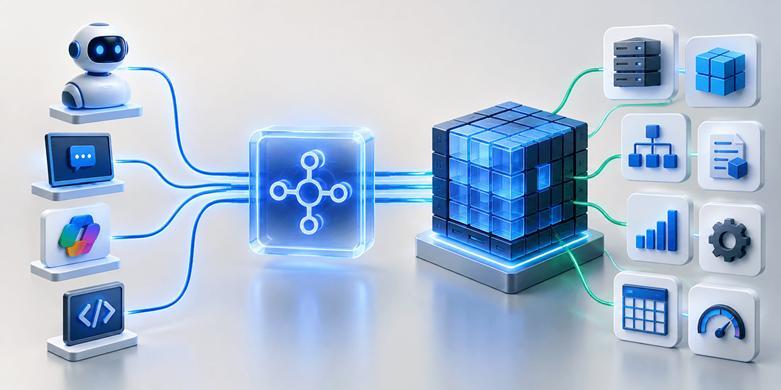
From Querying Data to Working with TM1
This is where MCP becomes particularly interesting.
IBM's MCP tooling is not limited to retrieving cube data. IBM also documents capabilities involving TM1 processes, server information, operational metrics, and AI-assisted MDX.
That creates the potential for AI agents to participate in more sophisticated Planning Analytics workflows.
A user might ask:
"Which regions are driving our forecast variance?"
Rather than analyzing an exported spreadsheet, an AI agent could use MCP tools to interact with the relevant TM1 model, query the appropriate data, and return an explanation based on the planning environment itself.
The interaction begins to shift from:
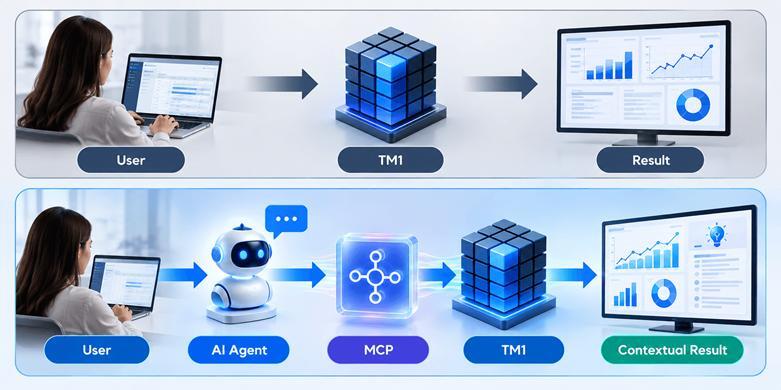
IBM Is Making MCP Easier to Implement
IBM has also consolidated its Planning Analytics MCP tools behind a unified MCP endpoint.
Instead of developers managing separate integrations for different groups of Planning Analytics tools, an agent can access available capabilities through a common interface.
For organizations experimenting with custom AI agents, this could make TM1 easier to incorporate into broader agentic workflows.
What This Means for TM1 Professionals
MCP does not reduce the importance of good TM1 architecture.
It may actually increase it.
If AI agents increasingly rely on TM1 models to understand data, generate queries, analyze results, or interact with supported processes, then well-designed cubes, clear hierarchies, reliable processes, security, and governance become even more important.
AI is only as useful as the planning context it can safely access and understand.
For experienced TM1 teams, that means MCP is less about replacing TM1 expertise and more about creating a new way to use it.

Is TM1 Becoming a Planning Engine for AI Agents?
That may be the bigger story.
For years, users have interacted with TM1 through spreadsheets, Planning Analytics Workspace, dashboards, APIs, and custom applications.
MCP introduces another potential interface: AI agents.
IBM is creating structured ways for those agents to discover TM1 resources, query multidimensional data, interact with processes, and access operational information.
That could position TM1 not simply as a system that AI analyzes from the outside, but as a governed planning engine that AI agents can interact with directly.
The future of Planning Analytics may therefore be less about adding AI on top of TM, and more about giving AI a structured, governed way to understand and use what organizations have already built inside it.