
Planning teams have long wrestled with a familiar problem: forecasts that are painstakingly built in spreadsheets, disconnected from live data, assumption-based and inaccurate, and outdated by the time they reach a decision maker’s desk. Pigment’s Predictions feature was designed to solve that and takes it a step further by bringing machine learning directly into the planning workflow.
This article breaks down what Predictions is, how it works, and how it can be implemented to establish a strategic, data-driven Integrated Business Plan fostering cross-functional collaboration. No data science background required.
What is the Predictions Tool?
Pigment’s Predictions is a built-in machine learning forecasting capability that allows planners to generate statistically-driven forecasts from their existing data, all within the same platform they use to model, plan, and report.
Instead of exporting data to a separate BI tool or relying on a data science platform to run models, business users can train and apply predictive models directly in Pigment. The models analyze historical trends in your data and use them to project future values.
How does it work?
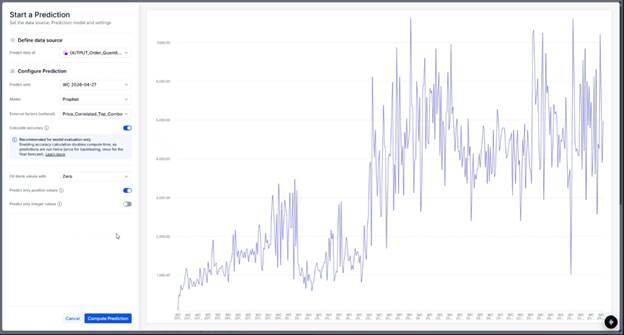
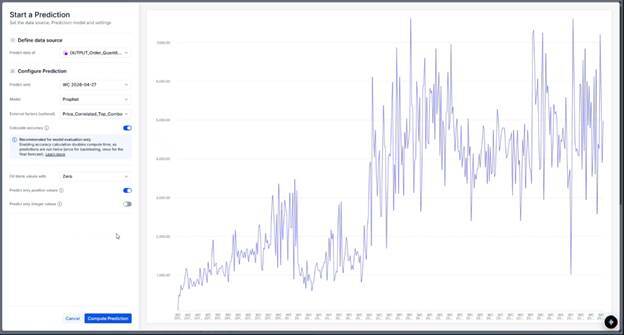
At a high level, Predictions follows the following workflow:
- Select your data. You point the tool at a metric in your Pigment application that has time-series data and that you would like to forecast. Volume by month, headcount by week, etc.
- Configure the model. Once you’ve established what data to use, you will establish the parameters that define the forecast: how far out do you want to predict, choosing an algorithm, external factor inclusion, accuracy metrics, etc.
- Generate a forecast. The model produces a forward-looking prediction for your chosen time horizon, along with confidence intervals that indicate the expected range of outcomes.
- Save the prediction. After reviewing, you can store the prediction results in a metric to use inside of your Pigment application where they can be reviewed further, adjusted, or used as a baseline alongside other drivers or assumptions.
Most importantly, the entire process happens inside Pigment. There is no need for exports, external code, or hand-off to IT.
Why it matters for business planners?
Traditional forecasting relies heavily on manual extrapolation; analysts look at last year’s actuals, apply some growth factor, and call it a forecast. This approach is time-consuming and inaccurate.
Predictions improve on this approach by:
- Reducing manual effort. Statistical baselines are generated automatically, freeing planners to focus on judgment-driven adjustments rather than mechanical number crunching.
- Improving consistency. Every forecast is derived from the same logic, making it easier to compare across teams, regions, or business units.
- Surfacing seasonality and trends. Time-series data is generally highly seasonal, which can be tough to identify using manual methods. Predictions pick up these patterns.
- Making uncertainty visible. Confidence intervals give decision makers an honest view of the range of likely outcomes.
- Improved accuracy. Since the tool uses historical data to learn from, forecast errors are minimized. The tool also allows for the optional inclusion of external factors which can further increase accuracy.
What to keep in mind
Predictions is a powerful tool, but like any forecasting method, it works best when used thoughtfully:
- Data quality matters. The model is only as good as the historical data behind it. Clean, consistent, sufficiently long time-series data will yield better results.
- It’s a baseline, not the final answer. Machine learning forecasts reflect past patterns; they do not account for strategic shifts, market disruptions, or management decisions. A planner’s adjustments still remain essential.
- More history will yield better accuracy. Data with at least 12-24 months of historical data will generally see stronger model performance than those with shorter histories.
- Evaluate your forecasts. Before saving and submitting the results of an output, be sure to evaluate accuracy. Create back tests, use different algorithms, or include external predictors if available and observe how the accuracy of each run varies.
Limitations
While Predictions is a powerful tool, it is not without its limitations:
- Not all time-series are predictable. Highly volatile or intermittent datasets are difficult for any machine learning method to forecast. It is recommended that when dealing with these datasets, a more naïve, assumption-driven approach is used.
- Algorithms can only learn from the data sources they are exposed to. Events that are not seasonal and not reflected in history will be missed by a forecast. If these events are planned and can be captured in a data source, consider using it as an external predictor, otherwise account for these events using adjustments.
- Highly granular forecasting is not recommended. Increasing the level of detail of a data source will increase compute time and generally decrease accuracy. It is recommended to use machine learning models at a grain that will supply consistent, non-sparse data.
Putting it all together
Forecasting has always been part of art, part science. The best planning teams don’t just crunch numbers; they tell a story about where the business is headed and why. Predictions don’t replace that story; it gives your team a stronger, more defensible starting point for telling it.
By embedding machine learning directly into the planning workflow, Predictions remove the friction between data and decision-making. Finance teams spend less time iterating on the baseline and more time making business decisions. Revenue leaders get an objective anchor for pipeline conversations. And the entire organization can move from reactive reporting to proactive planning, all within a single connected platform.
The result isn’t just better forecasts. It’s more confident decisions, made faster, with the data to back them up.
Ready to see Predictions in action? Book a demo and we'll walk you through how it works with your data. https://quebit.com/talk-to-an-expert/