
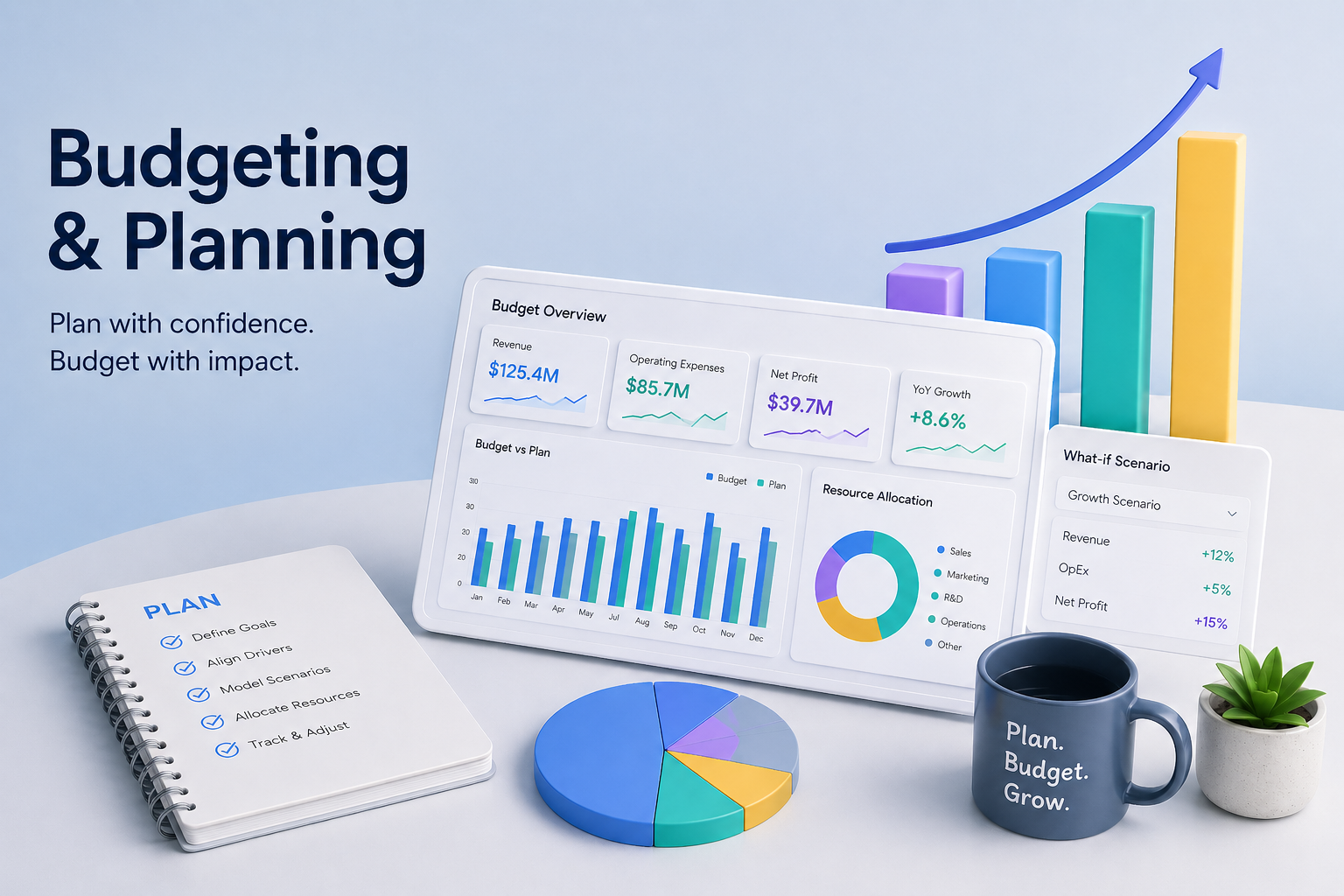
Why financial budgeting and planning in Pigment means your plan moves as fast as your business does.
Picture this. It's February. Your team spent the better part of Q4 building the annual budget. Countless spreadsheet versions, cross-functional alignment meetings, approval chains that stretched into December. The numbers finally got signed off. And now, six weeks later, two major customers have churned, a new important hire has on-boarded at a much higher salary than planned, all macroeconomic indicators are running materially worse than assumed and the CFO is asking why the forecast doesn't reflect any of this.
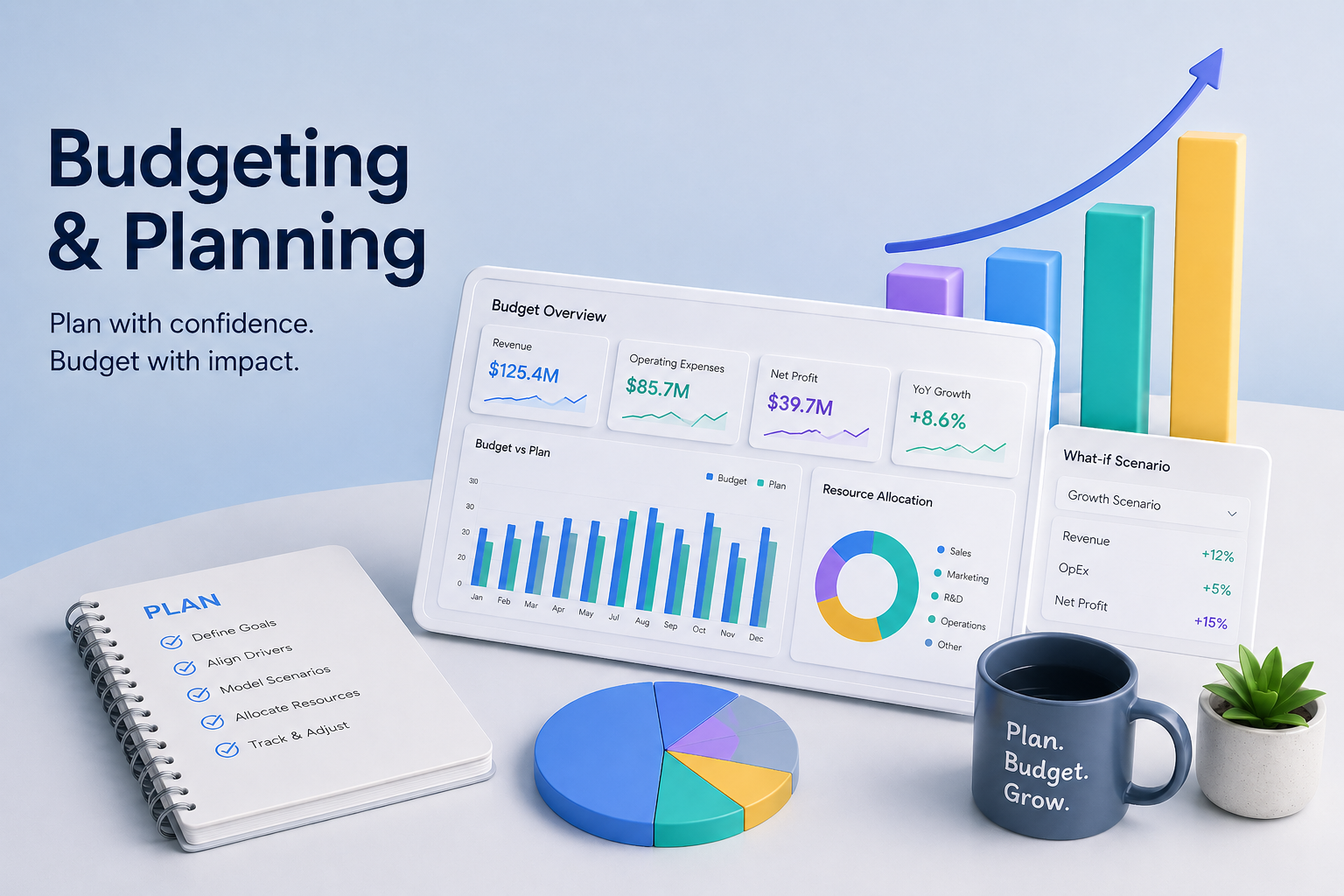 Nobody is surprised. Everyone is frustrated. And the budget, that carefully constructed document your team bled over, is already a historical artifact.
This isn't a failure of effort. It's a failure of design. Most financial budgeting and planning processes were built for a world that moved slower, and most of the tools finance teams have been using weren't built to support high levels of change. Pigment is different - it was specifically developed to support the real-world realities of modern fast-moving businesses
The Annual Budget Was Never Built to Flex
The traditional approach to financial planning and analysis treats the budget like a deliverable. You build it, you submit it, you defend it, and then you spend the rest of the year explaining why actuals don't match it.
The problems are predictable, and most FP&A teams know them by heart.
- Version control chaos. By the time the final budget is approved, there are nine versions of the same spreadsheet floating across departments. Budget_FINAL_v3_USE THIS ONE is not a system of record. It's a liability.
- Planning in silos. Sales submit their revenue assumptions. HR submits headcount. Cost Centers submits OPEX. Nobody is working from the same set of drivers, and nobody reconciles the assumptions until after consolidation, when it's too late to course-correct cleanly.
- Models that only one person can run. The analyst who built the model leaves or gets pulled onto another project, and suddenly nobody knows how to update the Q3 reforecast without breaking the business logic.
- Cycles that are too slow to matter. By the time a reforecast is complete, the business condition it was responding to has already shifted again.
The result is a finance team that spends most of its time maintaining a plan rather than informing decisions. Pigment is designed to break that cycle.
How Pigment Changes the Model
Pigment is an AI-native enterprise performance management (EPM) platform built around the idea that financial budgeting and planning should be continuous, connected, and collaborative, not an annual event that locks your thinking in place.
At the core of how Pigment handles budgeting is a flexible, driver-based modeling environment. Rather than locking in a fixed set of numbers, you build around the assumptions that actually cause the numbers to move: revenue per rep, average contract value, headcount by department, COGS driven from revenue. When those inputs change, downstream figures update automatically across every connected statement. Pigment's modeling engine handles the complexity, so the finance team handles the thinking.
Pigment's scenario planning takes this further. Rather than presenting leadership with a single plan and a variance explanation, finance teams can run multiple scenarios simultaneously on Pigment's highly scalable data engine, each tied to a specific set of business assumptions, showing the P&L impact of each path in real time. Comparing multiple scenarios is a simple mouse click user operation. That's a lot more than just reporting. This is the kind of strategic advisory work that CFOs are increasingly expecting from their FP&A teams.
Rolling forecasts become genuinely manageable in Pigment. Because the model is already built and the drivers are already connected, updating a rolling forecast isn't a rebuild from scratch. It's a matter of refreshing assumptions, with Pigment AI helping surface where the most significant changes have occurred and what they mean for the outlook.
Pigment AI adds another layer. Finance teams can query their planning data in natural language, getting instant answers to questions like "which departments are tracking above budget this quarter" or "what products and customers are the most profitable ear to date," without building a report or asking an analyst to pull numbers. Pigment's AI capabilities help you focus on what matters most, identifying anomalies before they become surprises.
Collaboration That Actually Works
One of the most underappreciated problems in financial budgeting and planning is that it's inherently cross-functional, but most tools treat it like a finance-only exercise.
Pigment's built-in collaboration features change that. Budget owners across the business can log into Pigment directly, see their own numbers, update their own assumptions within the guardrails finance has defined, and track their metrics against budget in real time. They don't submit a spreadsheet template and wait for finance to tell them where they stand. They see it themselves.
When a variance appears and needs explanation, finance can tag a business partner directly in Pigment. Notifications go out automatically, the conversation happens in context, and the commentary is attached to the relevant data point, not buried in an email chain nobody can find six weeks later.
Pigment's workflow automations reduce the manual coordination that consumes so much of the planning cycle. Alerts fire when budgets are exceeded. Approval requests route to the right people automatically. Finance spends less time chasing submissions and more time on analysis.
For IT and finance leadership thinking about governance, Pigment's granular access controls mean that every user, whether a business unit lead, an FP&A analyst, or a senior executive, sees exactly what they should see and can interact with exactly what they're authorized to touch and change. No more locked PDFs. No more managing permissions in a shared spreadsheet.
What It Looks Like When It Works
When financial budgeting and planning runs on Pigment, a few things change in ways that are immediately visible.
The planning cycle gets shorter. What used to take six to eight weeks from kickoff to approval compresses significantly, because the model is already built, the drivers are already connected, and the process becomes one of updating assumptions rather than rebuilding from scratch.
Variance analysis happens in Pigment, on the same platform where the plan was built. Finance can see budget versus actuals versus forecast on a single screen, with variances surfaced automatically and waterfall charts showing exactly where and why the numbers moved. Commentary gets added directly in the platform. The story is always attached to the data.
Leadership walks into board meetings with current numbers. Not last month's numbers. Not numbers that were accurate when the deck was built on Thursday but have since shifted. Current numbers, built in Pigment, connected to the drivers, traceable to their source.
The QueBIT Perspective
At QueBIT, we implement Pigment for business teams across a wide range of industries. The implementations that deliver the most impact share a common starting point: a clear answer to the question of what business decisions the model needs to solve.
Pigment provides business teams with extraordinary amount of flexibility, and this amounts to one of its greatest strengths. But flexibility without intentional design produces models that are technically powerful but practically underused. QueBIT helps translate Pigment’s enormous flexibility into a planning architecture that fits the way businesses actually operate, and ensures that business teams are set up to succeed by using Pigment the way it was intended, delivering both high business value and strong user adoption.
The technology is ready. The question is whether your process is.
Ready to Rethink Your Planning Process?
If your budgeting cycle still feels more like an annual event than a continuous capability, QueBIT can help you get there. As a certified Pigment implementation partner and Pigment's North American Partner of the Year, we work with finance teams to design and build planning solutions that flex with your business, not against it. Talk to a Pigment expert at QueBIT.